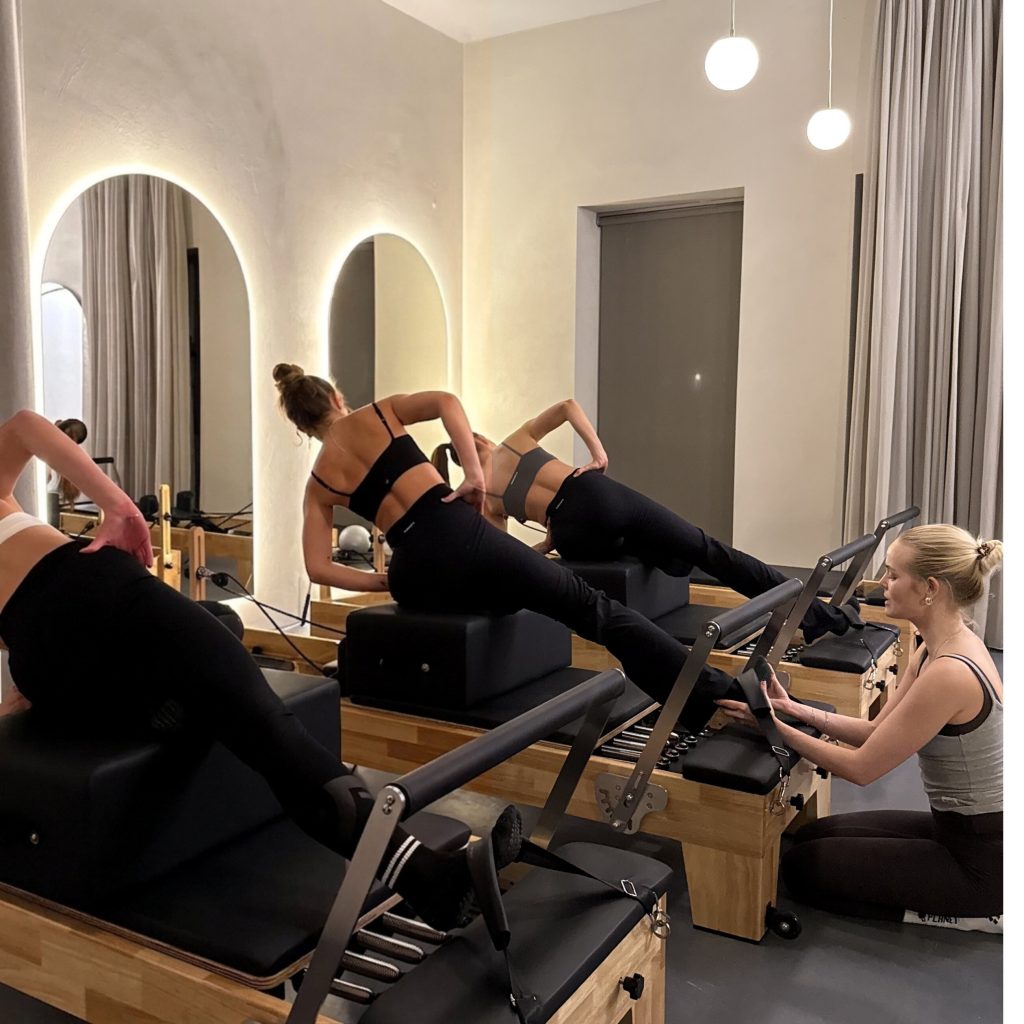
Rama Academy · Copenhagen
Learn the system. Understand the movement. Teach the body in front of you.
Programme overview
Are you looking to become a Reformer Pilates instructor, or are you already teaching and want to deepen your understanding of the method?
Over six weekends we explore the classical Reformer repertoire from Basic through Intermediate to Advanced. You will learn not only how to perform and teach the exercises, but also why they were created, how they connect, and how the system works as a whole.
This training gives you a deeper understanding of the Reformer apparatus, the original exercises developed by Joseph Pilates, and the principles behind them. By understanding where the method comes from and how the exercises work together, you develop knowledge that can be applied across different teaching styles.
Whether you want to teach fully classical Pilates, bring its principles into contemporary Reformer classes, or develop your own approach, this course gives you a foundation to build on. The focus is on understanding what you teach, why you teach it, and how to adapt it to the person in front of you.
Your instructor
A forever excited student of the method.
Marta is a classical Pilates instructor and founder of Mermaid Pilates, a private studio in Copenhagen.
Her education includes the Extensive Reformer programme at Libelt Pilates Academy in Sopot, Poland, alongside learning from experienced teachers including Michael Johnson, Elaine Ewing, Rodrigo Nanno and Sean Gallagher. Her teaching experience covers contemporary, classical and archival exercises.
Her teaching extends beyond the Reformer to classical Matwork and other apparatus, reflecting her understanding of Pilates as a complete, interconnected system. She continues to deepen her knowledge through workshops, education and practice, respecting the classical foundations while staying curious and adapting her teaching to individual needs, with the guiding philosophy of teaching the body in front of you.
Is this for you?
You do not need to commit to teaching exclusively classical Pilates. The knowledge gained throughout this training can support a variety of teaching approaches.
Pilates is more than a collection of movements. It is a system developed with intention, where exercises connect, build upon one another and serve a purpose.
Our goal is to help you understand that system, develop your eye as a teacher, and give you the tools to make informed decisions in your own classes. Whether your future lies in classical Pilates, contemporary Reformer or somewhere in between, understanding the foundations will make you a more knowledgeable and confident instructor.
How the course works
| Module | Days | Hours | Focus |
|---|---|---|---|
| Basic | 1–4 | 20 | Foundation, Basic repertoire and teaching principles |
| Intermediate | 5–8 | 20 | Intermediate repertoire, Swan Prep and practical teaching |
| Advanced | 9–12 | 20 | Advanced repertoire, Full Swan, integration and teaching |
| Total | 12 | 60 |
The programme follows a progressive structure. Some exercises are introduced earlier to build a foundation for more advanced movements. Once an exercise has been covered it is not taught from scratch again; instead it is revisited in the context of the bigger picture, exploring connections, progressions and how the classical system works as a whole.
Learn the foundational repertoire, apparatus setup, spring settings and essential teaching principles. Develop an understanding of the movements and how to communicate them effectively.
Build on the Basic repertoire with new exercises, more complex movement patterns and teaching progressions. Explore how exercises connect and how to recognise when a client is ready to progress.
Explore the Advanced repertoire, refine your understanding of movement, and develop the skills to approach more challenging exercises with confidence and control.
Teaching development
The following framework applies to every exercise introduced throughout the Basic, Intermediate and Advanced modules.
Practical work
Practical teaching is incorporated throughout all three modules.
The examination is arranged individually following the course and takes place outside the 60 contact hours. The theoretical assessment may cover the history of Pilates and the classical system, the Basic, Intermediate and Advanced orders, spring settings and apparatus safety, traditional repetitions, anatomy and biomechanics, and modifications and injury considerations.
The practical assessment covers teaching an assigned participant or practice client, exercises selected from the three orders, verbal and hands-on cueing, observation and corrections, exercise modifications, safe apparatus use, and teaching methodology.
Certification. Participants who successfully complete the course requirements and pass the examination receive a Rama Academy certificate of completion.
The details
Still to confirm
Dates of the next intake, and the maximum group size. These are not in the programme document, so they have deliberately been left blank rather than guessed — send them over and they go straight in.
Enrolment
Payment confirms your place on the next intake. Questions before you book? Write to hello@ramareformerclub.com.
Early-bird price — until 30 November 2026. From 1 December 2026 it is DKK 11,900.
Questions
No. The training is open to aspiring instructors who want a strong foundation before they begin teaching, and to dedicated practitioners exploring the method beyond their own practice. It is equally for contemporary Reformer instructors who want to understand where the exercises come from, and for classical instructors deepening their knowledge of the traditional system.
No. You do not need to commit to teaching exclusively classical Pilates. The knowledge gained throughout this training can support a variety of teaching approaches — fully classical, contemporary Reformer, or an approach of your own.
Three modules over six weekends: Basic (days 1–4), Intermediate (days 5–8) and Advanced (days 9–12), each 20 contact hours. The programme is progressive — once an exercise has been covered it is not taught from scratch again, but revisited in the context of the bigger picture, exploring connections and progressions.
Twenty hours of independent practice and teaching, alongside the 60 contact hours. That covers personal Reformer practice, teaching practice with other participants or practice clients, observation of teaching in various styles, repertoire review and preparation for the practical examination.
Individually, following the course, and outside the 60 contact hours. It covers theory — the history, the three orders, spring settings and apparatus safety, traditional repetitions, anatomy and biomechanics, modifications and injury considerations — and a practical teaching assessment with an assigned participant or practice client.
Participants who successfully complete the course requirements and pass the examination receive a Rama Academy certificate of completion.
At Rama Academy in Copenhagen — Strandlodsvej 13Y · 2300 København. The format is in-person, hands-on training with practical teaching and feedback throughout.
